
Precision Manufacturing with 5 Axis CNC Machining for Complex Parts


5 axis CNC machining for complex parts provides manufacturers and product development teams with an efficient way to produce components that contain difficult angles, curved surfaces, deep features, and multiple machining faces. Compared with conventional machining methods that require frequent repositioning, five-axis machining allows the cutting tool to approach a workpiece from multiple directions while maintaining controlled tool movement.
For prototype development and low-volume precision production, this flexibility can reduce unnecessary setups and make challenging geometries easier to manufacture. SHD PROTOTYPE uses CNC machining as part of its manufacturing support for customers developing functional prototypes and precision metal or plastic components.
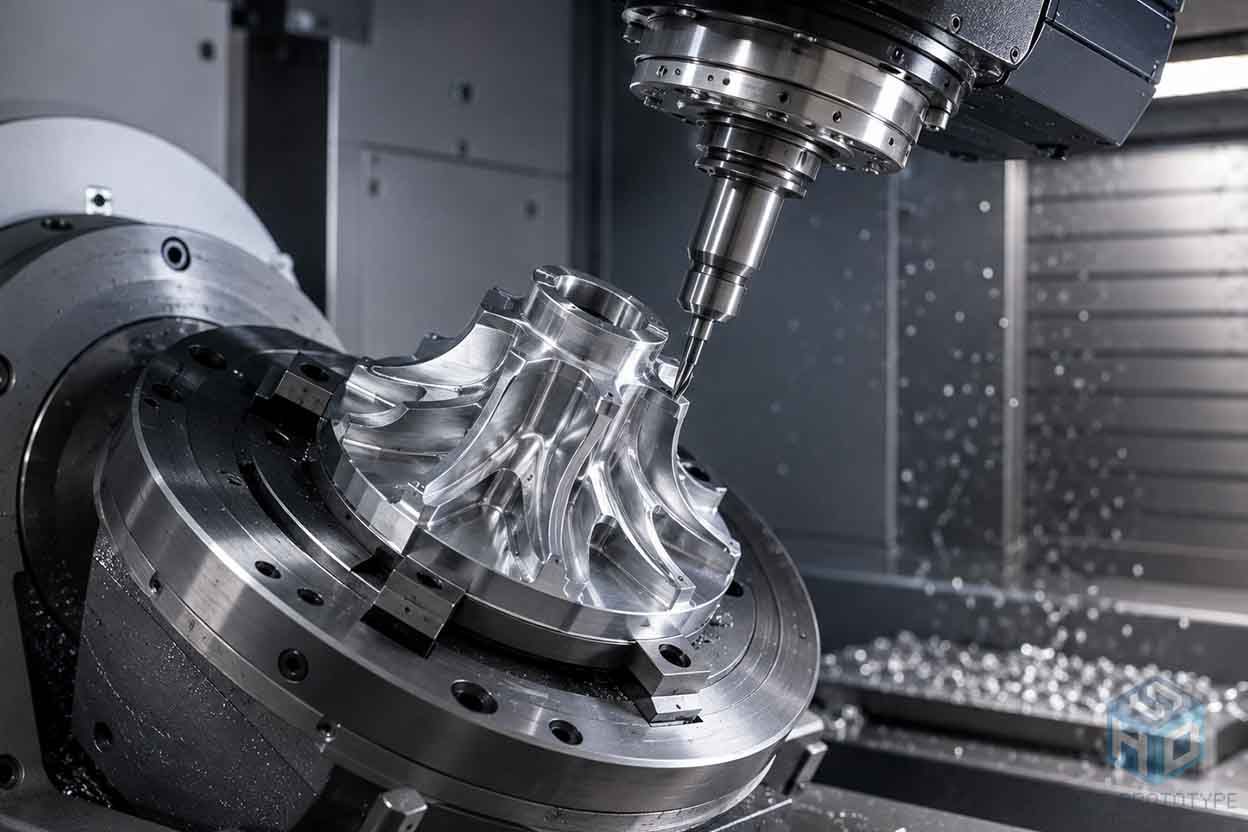
How 5 Axis CNC Machining for Complex Parts Improves Manufacturability
A major challenge when producing complex CNC parts is maintaining the correct relationship between features located on different surfaces. With conventional three-axis machining, a component may need to be removed, rotated, repositioned, and realigned several times before machining can continue. Every additional setup introduces another opportunity for positioning variation.
5 axis CNC machining for complex parts can reduce the number of separate setups by allowing the tool or workpiece orientation to change during machining. Features located on several sides of a component can therefore be accessed more efficiently.
This approach is particularly useful for components containing:
-Angled holes and mounting surfaces
-Contoured or curved geometries
-Deep cavities
-Closely positioned features
-Multiple precision surfaces
-Difficult tool-access areas
The objective is not simply to make machining faster. It is to create a manufacturing process that maintains feature relationships more consistently.
Producing Complex CNC Parts with Fewer Setups
Not every complicated-looking component automatically requires five-axis machining. A well-designed part may still be manufactured effectively using three-axis CNC equipment. However, when complex CNC parts require machining from several orientations, reducing repeated workholding can become valuable.
Fewer setups may help improve dimensional consistency while simplifying the machining sequence. This is especially relevant when one feature must remain accurately positioned relative to another feature on a different face. Tool accessibility also matters. Tilting the workpiece or tool can sometimes provide a more suitable cutting angle and reduce the need for excessively long cutting tools.
For engineers, this means that 5 axis CNC machining for complex parts can expand design freedom while still keeping manufacturability in consideration.
Supporting Rapid CNC Prototyping
During product development, engineers often need physical components before committing to production tooling or a larger manufacturing program. Rapid CNC prototyping allows teams to evaluate dimensions, assembly relationships, mechanical performance, surface requirements, and overall design feasibility using parts made from engineering materials.
When prototypes contain complicated geometry, 5 axis CNC machining for complex parts can make it easier to reproduce the intended design without simplifying important features solely for machining convenience.
At SHD PROTOTYPE, engineering review is an important part of the machining process. Before manufacturing begins, factors such as material choice, tool access, internal corner geometry, wall thickness, tolerances, and finishing requirements should be considered together.
This helps ensure that rapid CNC prototyping supports meaningful product verification rather than simply producing a visually similar model.
Material and Design Considerations
Successful machining depends on more than CNC equipment. Material characteristics affect cutting forces, achievable surface quality, tool selection, and machining strategy. Aluminum alloys are commonly selected for lightweight engineering applications, while stainless steel may be preferred where corrosion resistance or mechanical strength is important. Engineering plastics can also be suitable for functional prototypes and specialized assemblies.
For complex CNC parts, designers should pay particular attention to deep pockets, extremely thin walls, inaccessible internal corners, and unnecessarily tight tolerances.
A drawing that specifies very demanding tolerances across every dimension may increase machining difficulty without improving actual product performance.
For this reason, SHD PROTOTYPE encourages customers to define critical dimensions separately from general dimensions whenever possible.
From Prototype Geometry to Practical Manufacturing
One advantage of rapid CNC prototyping is that manufacturing feedback can be incorporated while the design is still flexible. For example, a deep cavity may require a longer cutting tool than expected, an internal corner may need a practical radius, or an angled feature may benefit from a different machining orientation.
Identifying these issues early can make later production decisions easier. Rather than treating 5 axis CNC machining for complex parts as simply a machine capability, it is more useful to view it as part of a broader manufacturing strategy involving geometry analysis, workholding, tooling, tolerances, material behavior, and inspection.
Conclusion
5 axis CNC machining for complex parts is particularly valuable when components combine multiple machining directions, complex surfaces, precise feature relationships, and challenging tool access. By reducing repeated setups and improving machining flexibility, it can support both prototype development and low-volume precision manufacturing.
SHD PROTOTYPE works with customers developing complex CNC parts, helping evaluate drawings, materials, machining requirements, and practical production considerations before manufacturing begins.
For engineers planning a rapid CNC prototyping project, SHD PROTOTYPE can review your CAD files and technical requirements to determine whether 5 axis CNC machining for complex parts is an appropriate manufacturing solution.
FAQ
Q1: When is 5-axis CNC machining more suitable than 3-axis machining?
Five-axis machining is generally more suitable when a component requires machining from several orientations, contains complex contours, or includes features that are difficult to reach with conventional three-axis tool movement.
Q2: Does every complex CNC part require five-axis machining?
No. Some complex CNC parts can still be produced efficiently with three-axis machining and suitable workholding. The best process depends on geometry, tolerance requirements, quantity, material, and tool accessibility.
Q3: What materials can be used for rapid CNC prototyping?
Common options include aluminum alloys, stainless steel, engineering plastics, brass, copper, and other machinable materials. The appropriate material should be selected according to the prototype's functional and testing requirements.
Q4: Can five-axis machining reduce machining errors?
It can reduce errors associated with repeated repositioning because more features may be machined within fewer setups. Final accuracy still depends on machine condition, tooling, workholding, process control, and inspection.
Q5: What files are useful when requesting a CNC machining quotation?
A 3D CAD model is normally the most useful starting point. Technical drawings can additionally specify critical tolerances, threads, surface finishes, materials, and other requirements that may not be fully defined in the CAD geometry.