
Automotive Steering Knuckle CNC Machining for Precision Fit


Automotive steering knuckle CNC machining is used to finish critical features on one of the key structural components connecting the wheel, suspension, hub, and steering system. A steering knuckle may begin as a forged, cast, or otherwise near-net-shape blank, but several functional areas still require precision machining before assembly. These areas can include bearing bores, mounting faces, bolt holes, ball-joint interfaces, and other locations where dimensional relationships directly affect fit and alignment. For this reason, CNC machining is not simply a finishing step. It helps turn a shaped metal blank into a component with controlled functional geometry.
How Automotive Steering Knuckle CNC Machining Controls Critical Features
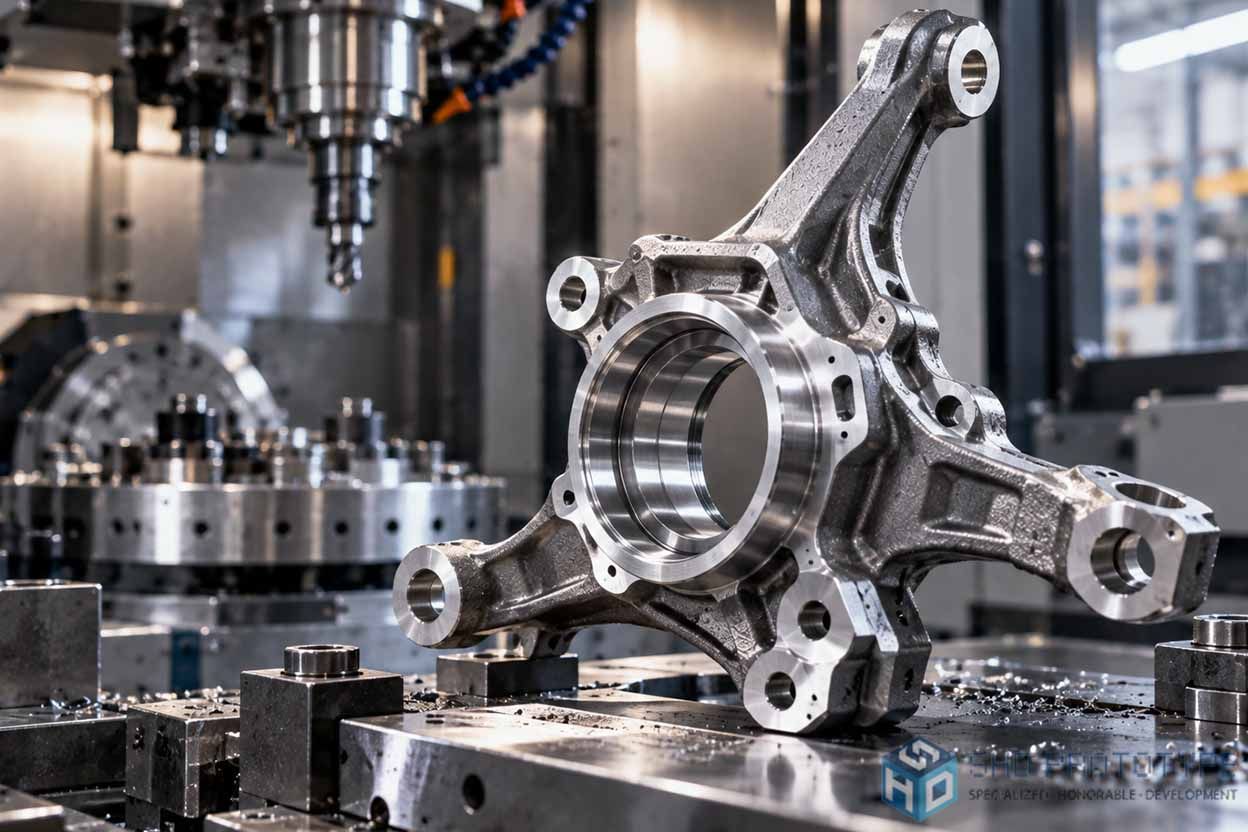
One of the most important areas is the wheel-bearing bore. The bore must maintain its required diameter, position, and relationship with surrounding mounting features. If several functional surfaces are machined in separate setups, every repositioning step introduces another opportunity for alignment variation.
A clear datum strategy is therefore important in precision automotive machining. Fixtures need to locate the part consistently while providing enough support to resist cutting forces without distorting the component.
Multi-Axis Machining Helps with Complex Geometry
Steering knuckles rarely consist of simple flat surfaces. Their geometry may include angled arms, recessed mounting positions, bores on different orientations, and irregular outer profiles.
Multi-axis CNC machining can improve access to these features by allowing the tool or workpiece to approach from several directions. This can reduce unnecessary reclamping and make it easier to maintain positional relationships between features located on different sides of the component. However, multi-axis capability does not remove every machining challenge. Tool length, fixture clearance, casting or forging variation, and accessibility around complex shapes still need to be considered when planning the process.
Roughing and Finishing Serve Different Purposes
A near-net-shape steering knuckle may still require material removal around critical bores and mounting surfaces. Rough machining removes excess stock and establishes the basic geometry. Finishing operations then create the final dimensions and surface conditions required by the drawing.
Separating these stages can be useful where substantial stock removal may release internal stress or create temporary dimensional changes. Tool wear also matters. A worn cutting edge can gradually affect bore size, surface finish, and dimensional consistency, so critical features require appropriate tool and inspection control throughout production.
Inspection Follows Functional Relationships
Not every surface on a steering knuckle needs the same level of dimensional control. Inspection should focus on features that influence wheel-bearing location, suspension attachment, steering geometry, and assembly interfaces. This is why a useful technical drawing should clearly define datums, critical tolerances, hole positions, surface requirements, and relationships between mating features.
For buyers, communicating these priorities can help the machining supplier focus process control where it provides the most functional value.
Conclusion
Automotive steering knuckle CNC machining combines part geometry, fixturing, datum planning, tool access, machining sequence, and dimensional inspection. The value of CNC machining is not simply producing accurate individual holes or surfaces. It is maintaining the correct relationship between multiple functional features across a complex automotive component.
Early manufacturability review can help identify difficult tool access, unstable clamping areas, machining allowance issues, and unnecessary tolerance demands before production begins.
Automotive CNC Machining Support from SHD PROTOTYPE
SHD PROTOTYPE supports custom CNC machining projects based on customer drawings, 3D models, material requirements, functional features, and dimensional expectations. For automotive components with complex geometry, early review of machining datums, fixture locations, tool access, and critical surfaces can help create a more practical route from prototype evaluation to repeatable component manufacturing.
Frequently Asked Questions
Q01 | Can a steering knuckle be machined completely from solid stock?
It is technically possible for some designs, but production steering knuckles are commonly based on near-net-shape blanks because removing a large amount of material from solid stock may increase machining time and material waste.
Q02 | Why are machining datums important for automotive parts?
Datums provide consistent reference points for machining and inspection. They help control the relationship between bores, holes, mounting faces, and other functional features.
Q03 | Does multi-axis machining always eliminate secondary setups?
No. Some geometries may still require repositioning because of fixture access, tool reach, or inspection requirements. Multi-axis machining can reduce setups, but the actual process depends on the component design.