
The Five-Axis Machining Center Revolution Is Redefining Complex CNC Production


The five-axis machining center revolution is changing how manufacturers approach prototypes and low-volume components with angled faces, deep cavities, compound curves, and tightly related features. At SHD PROTOTYPE, we use this capability to reduce repositioning and preserve dimensional relationships across demanding parts.
Why the Five-Axis Machining Center Revolution Changes Part Strategy
Traditional three-axis milling moves along the X, Y, and Z directions. When a component has features on several sides, the operator may need to stop the machine, reposition the workpiece, establish a new datum, and continue machining. Every additional setup introduces time and another opportunity for alignment error.
A five-axis machining center adds two rotational movements, allowing the cutting tool to approach the workpiece from more directions. With simultaneous five-axis machining, linear and rotary axes can move together while cutting complex surfaces. This creates a route to complex CNC parts that would otherwise require multiple fixtures, long-reach tools, or separate operations.
Fewer Setups Improve More Than Lead Time
The most visible advantage of the five-axis machining center revolution is setup reduction, but the deeper benefit is continuity. Features produced without removing the part from its fixture are more likely to retain their intended positional relationship.
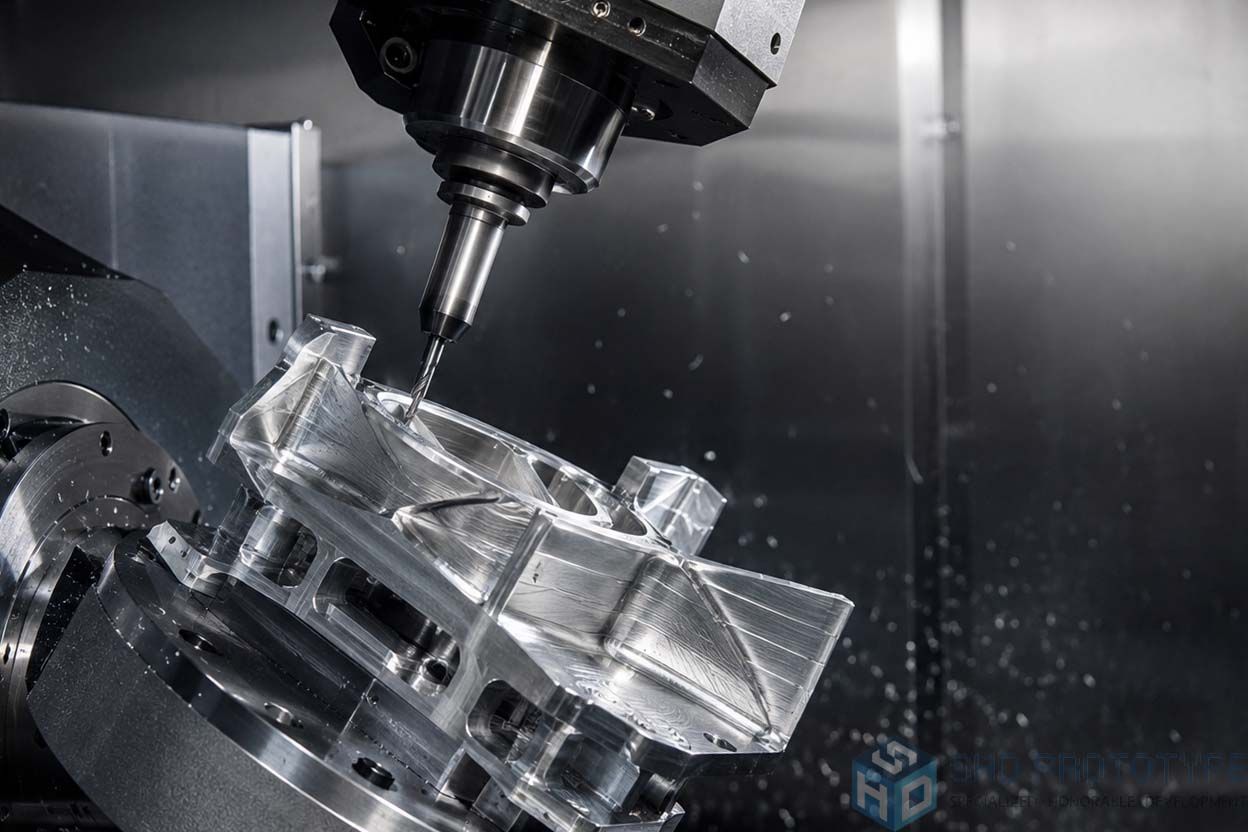
We often receive housings, impeller-like prototypes, robotic joints, and optical mounts with angled holes or contoured surfaces. For these complex CNC parts, one planned setup can replace several conventional operations. Shorter tools may also be used because the spindle can tilt toward the cutting area, improving rigidity and controlling vibration.
The Difference Between 3+2 and Continuous Motion
Not every five-axis project requires all axes to move at once. In 3+2 machining, the rotary axes position the workpiece at a fixed angle, and three-axis cutting follows. This is efficient for angled holes, side pockets, and multi-face machining.
Continuous simultaneous five-axis machining is more appropriate when the tool must constantly change orientation along a curved surface. At SHD PROTOTYPE, we select the strategy according to geometry, tolerance, material, tool access, and surface requirements.
This distinction matters because the five-axis machining center revolution is not about using maximum machine movement on every job. It is about choosing a toolpath that produces complex CNC parts with controlled risk and reasonable cost.
Advanced Equipment Still Requires Process Knowledge
A common misconception is that a five-axis machine automatically guarantees precision. Machine calibration, fixture rigidity, tool runout, thermal behavior, CAM programming, and collision verification all influence the result.
The five-axis machining center revolution therefore places greater responsibility on engineering preparation. Before machining, we review access angles, clamping locations, stock allowance, critical datums, and possible tool-holder interference. Simulation is important because rotational movement creates collision risks that may not exist in simpler milling.
For customers, identifying truly critical features is more useful than applying extreme tolerances to the entire drawing. This lets us focus process control where assembly, sealing, movement, or surface continuity depends on it.
Conclusion
The five-axis machining center revolution gives product teams an efficient way to develop integrated parts with fewer setups, better tool access, and stronger geometric continuity. Its real value appears when equipment, programming, inspection, and design decisions work together.
Turning Complex Geometry Into a Practical Prototype
At SHD PROTOTYPE, we apply the five-axis machining center revolution to prototypes and low-volume projects that require difficult angles, refined surfaces, or closely related features. Our team evaluates whether 3+2 positioning or simultaneous five-axis machining offers the better route for producing reliable complex CNC parts without unnecessary manufacturing complexity.