
Precision Machined Metal Parts Support Reliable Product Development


Precision machined metal parts play an important role in products that require accurate fit, stable performance, and dependable assembly. At SHD PROTOTYPE, we produce these parts for engineering validation, functional prototypes, low-volume production, and specialized OEM applications.
Unlike visual models, machined components are made from real engineering materials. This allows customers to evaluate strength, surface quality, dimensional relationships, and assembly behavior before committing to larger production programs.
Why Precision Machined Metal Parts Require Careful Process Planning
The quality of precision machined metal parts depends on more than machine capability. Material condition, tool selection, cutting sequence, workholding, and inspection planning all influence the final result.
Before machining begins, our engineers review the drawing and 3D model to identify critical dimensions, datum surfaces, thin walls, deep pockets, threads, and difficult tool access. This review helps us determine whether milling, turning, five-axis machining, or a combined process is more suitable.
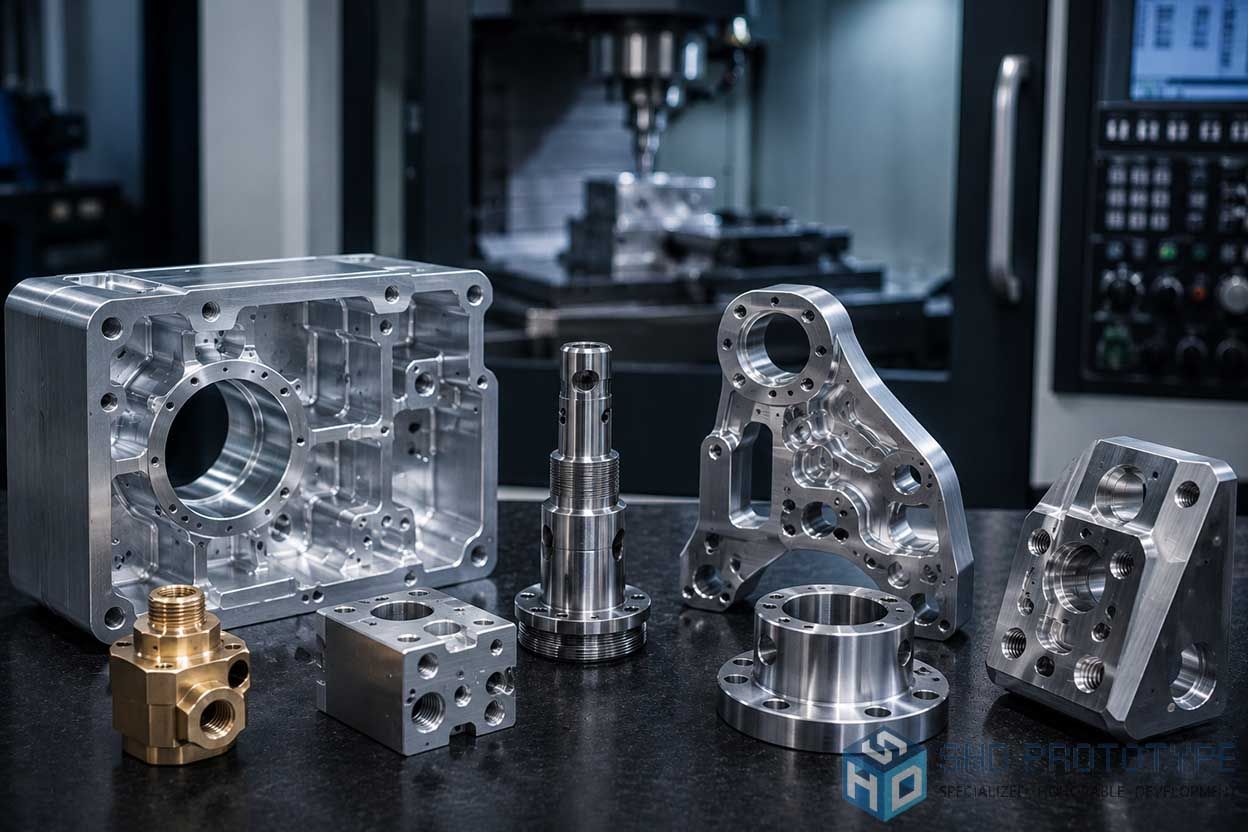
For custom machined metal components, the machining route should reflect how the part functions in the final assembly. A sealing surface, bearing location, or alignment feature may need tighter control than an external cosmetic surface.
Material Selection Shapes Machining Performance
Aluminum is frequently selected for lightweight housings, brackets, frames, and electronic enclosures. Stainless steel is more suitable for parts that require strength, corrosion resistance, or wear performance. Brass offers good machinability and is often used for connectors, fittings, and decorative mechanical details.
During CNC metal prototyping, the selected material should represent the intended application as closely as possible. Testing an aluminum prototype may not reveal the same behavior as a stainless steel production part.
At SHD PROTOTYPE, we also consider how the material reacts to heat, clamping pressure, and material removal. Thin or asymmetrical parts may move during machining, so the cutting sequence and fixture design must reduce internal stress and deformation.
Accuracy Must Be Applied Where It Matters
A common practical issue is applying very tight tolerances to every dimension. This increases production time and inspection cost without always improving the product.
For custom machined metal components, we recommend identifying the features that directly affect movement, sealing, load transfer, or assembly position. General surfaces can often use more practical tolerances.
This approach allows precision machined metal parts to achieve functional accuracy without unnecessary manufacturing complexity. It also helps us select appropriate inspection methods, including calipers, micrometers, height gauges, thread gauges, and coordinate measuring equipment.
From Prototype Quantities to Small Production Runs
CNC metal prototyping is valuable because the same basic machining route can often continue into low-volume production. After the first parts are tested, design changes can be introduced without modifying expensive production tooling.
This flexibility supports startups, research teams, industrial equipment manufacturers, and established OEM brands. Custom machined metal components may be produced as one-off test pieces, pilot batches, replacement parts, or specialized assemblies. At SHD PROTOTYPE, we record machining and inspection information during early production so later batches can be reproduced more consistently.
Conclusion
Precision machined metal parts provide a practical path from digital design to functional hardware. Their success depends on balanced tolerances, suitable materials, stable fixturing, controlled machining, and inspection focused on real product requirements.
Manufacturing Support for Accurate Metal Components
SHD PROTOTYPE supports precision machined metal parts from drawing review and CNC metal prototyping to finishing, inspection, and low-volume production. Our team develops custom machined metal components with attention to manufacturability, dimensional consistency, and final assembly performance.