
Precision Parts Maintenance Protects Mold Accuracy and Service Life


Precision parts maintenance is essential for mold inserts, core pins, guide components, ejector pins, shafts, and other closely fitted parts produced in a precision machining center. At SHD PROTOTYPE, we consider maintenance requirements during machining, inspection, cleaning, storage, and delivery because a correctly manufactured component can still lose accuracy through corrosion, impact, contamination, or improper handling.
Why Precision Parts Maintenance Begins After Machining
Completing the CNC program does not mean the part is ready to be handled like an ordinary metal component. Precision mold parts may contain polished surfaces, sharp sealing edges, narrow grooves, threaded holes, and tightly controlled diameters.
After machining, chips, cutting fluid, and fine abrasive particles must be removed carefully. Residue left inside holes or channels may later affect mold assembly or movement. Clean compressed air, suitable cleaning agents, and lint-free materials are commonly used without scratching functional surfaces.
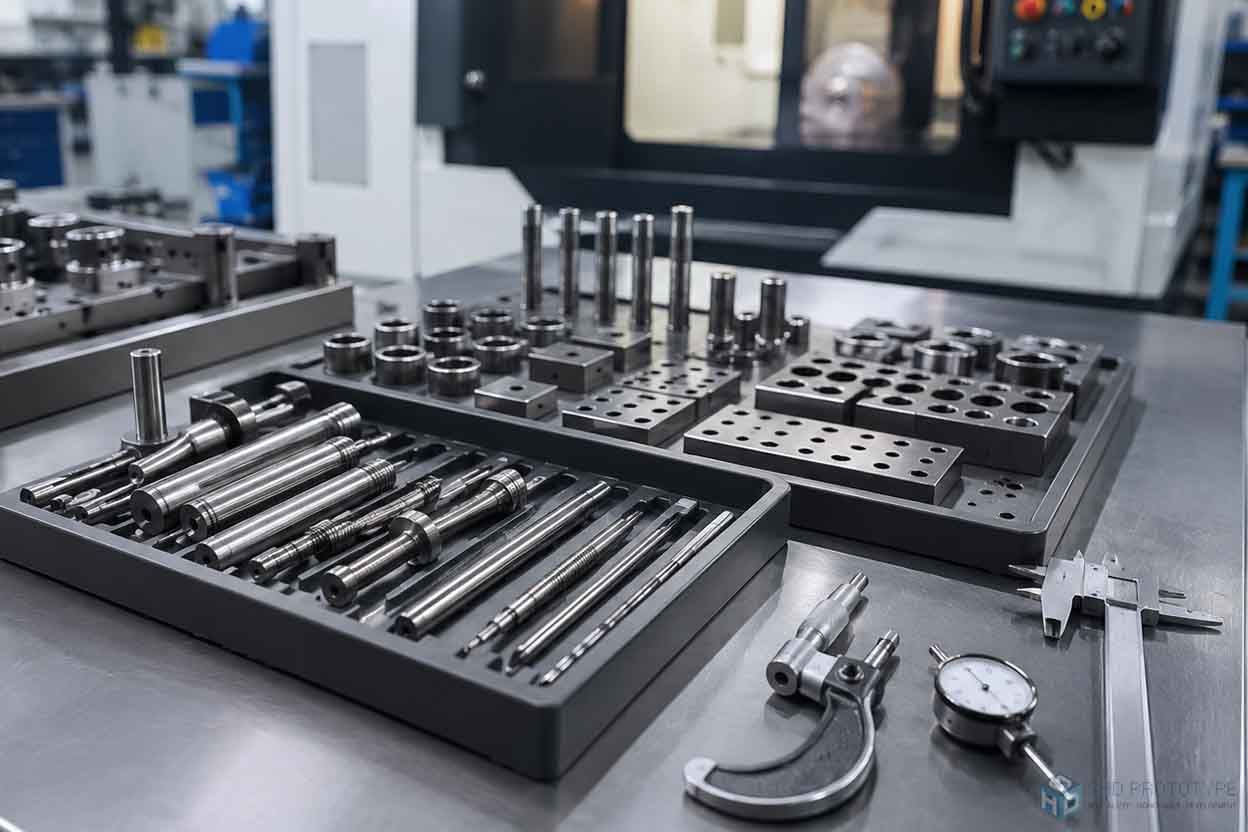
At SHD PROTOTYPE, precision parts maintenance also includes checking whether burrs remain around cross holes, slots, threads, or machined edges before the component enters final inspection.
Protecting Shafts, Pins, and Sliding Components
Shaft parts care is particularly important for guide pins, core pins, ejector components, and rotating mold parts. Small scratches or impact marks on a fitted diameter may create resistance during assembly or lead to uneven movement in service.
These parts should not be placed loosely together on a metal table. Individual separators, protective sleeves, or organized trays help prevent direct contact. A light protective oil may be applied when the material and final application allow it.
During shaft parts care, straightness, diameter, roundness, and surface condition should be checked together. A shaft may meet its basic diameter requirement but still perform poorly if it has been bent or locally damaged during handling.
Preventing Corrosion and Surface Damage
Workpiece protection becomes especially important when parts must remain in storage before assembly or shipment. Tool steel and other exposed metals may develop rust when they are handled with bare hands or stored in humid conditions.
Functional surfaces should be cleaned and dried before protective oil, anti-rust paper, or sealed packaging is applied. Polished mold surfaces may also require soft wrapping that does not leave fibers or adhesive residue.
At SHD PROTOTYPE, workpiece protection is selected according to the material, surface finish, shipping method, and expected storage period. Aluminum, stainless steel, brass, and hardened tool steel do not always require the same packaging method.
Maintenance During Mold Assembly
Precision parts maintenance continues when components are installed into the mold. Forcing a pin, insert, or shaft into position can damage both the component and its mating surface.
Assembly areas should be clean, and sliding components should receive the correct lubricant. When unusual resistance appears, the cause should be checked rather than overcome with greater force.
Consistent shaft parts care and controlled workpiece protection help reduce assembly problems and preserve the dimensional relationships established during CNC machining.
Conclusion
Precision parts maintenance protects mold accuracy by controlling cleanliness, corrosion, surface contact, lubrication, and handling. Proper care helps precision mold components retain their intended fit and movement from final inspection through assembly and service.
Supporting Reliable Mold Component Production
At SHD PROTOTYPE, precision parts maintenance is integrated into machining, deburring, inspection, cleaning, packaging, and delivery. Our team supports mold inserts, pins, shafts, and other precision components with practical workpiece protection and shaft parts care suited to prototype and low-volume manufacturing.