
Tight Tolerance CNC Machining Is More Than Just Holding Dimensions


Blogpost keywords: tight tolerance CNC machining, precision machined components, high accuracy CNC parts
Tight tolerance CNC machining is often discussed as a measurement capability, but in practice it represents an entire manufacturing system built around precision control. At SHD PROTOTYPE, customers frequently request increasingly strict dimensional requirements as products become more compact, complex, and performance-driven. While achieving a dimension on a drawing may appear straightforward, maintaining that dimension consistently across multiple parts requires much deeper engineering consideration.
Why Tight Tolerance CNC Machining Demands Process Control
Many CNC projects can be successfully produced with standard tolerances. However, once tolerances become more restrictive, factors that are normally insignificant begin to affect production results. Machine rigidity, tool wear, thermal expansion, material stability, cutting strategy, and inspection methodology all contribute to the final outcome.
For example, aluminum and stainless steel behave very differently during machining. Aluminum dissipates heat efficiently and is generally easier to machine, while stainless steel can generate significant cutting heat and tool wear. These material characteristics directly influence how precision machined components are produced.
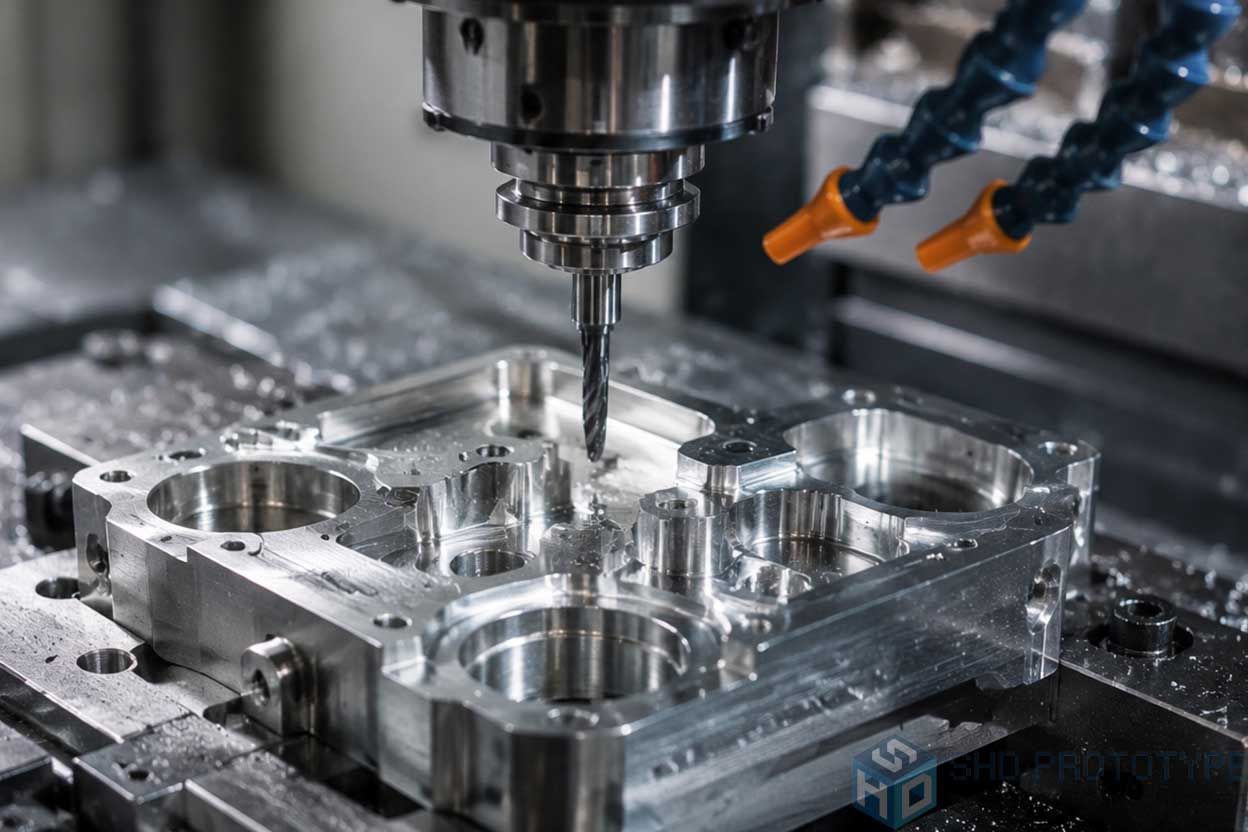
At SHD PROTOTYPE, process planning often begins long before the first machining operation starts. Material selection, fixture design, and machining sequence are evaluated together to reduce dimensional variation throughout production.
Understanding the Difference Between Standard and High Accuracy Manufacturing
A common misconception is that tighter tolerances simply require better machines. In reality, high accuracy CNC parts are the result of controlling multiple variables simultaneously.
Consider a component with several critical hole locations. Even if each individual feature is machined within specification, cumulative dimensional variation can create assembly issues when multiple features interact. This phenomenon, often called tolerance stack-up, becomes increasingly important as dimensional requirements become tighter.
For this reason, tight tolerance CNC machining frequently involves additional in-process inspections and controlled machining environments.
Common Design Challenges That Affect Accuracy
Designers sometimes specify extremely tight tolerances across an entire part without identifying which features are actually critical.
This approach increases manufacturing complexity and cost without necessarily improving functionality. In our experience, precision machined components perform best when tolerance requirements are assigned strategically. Functional surfaces, bearing locations, sealing interfaces, and assembly references typically deserve tighter control than cosmetic or non-critical features.
By focusing precision where it matters most, manufacturers can produce high accuracy CNC parts more efficiently while maintaining product performance.
Practical Considerations for Prototype and Low-Volume Production
During prototype development, tolerance verification often reveals opportunities for design improvement. A component may technically meet drawing requirements but still create assembly challenges due to interaction with neighboring parts. Early prototype testing helps identify these issues before production begins.
At SHD PROTOTYPE, tight tolerance CNC machining projects are typically reviewed from both manufacturing and application perspectives. Understanding how a part functions in the final assembly often leads to better machining strategies and more reliable results.
This collaborative approach helps customers avoid unnecessary manufacturing costs while achieving the precision their products require.
Conclusion
Tight tolerance CNC machining depends on much more than machine capability. Successful production requires careful process planning, material understanding, and inspection control to consistently produce precision machined components and high accuracy CNC parts.
Precision Manufacturing Starts with Engineering
At SHD PROTOTYPE, we specialize in tight tolerance CNC machining for prototype development, engineering validation, and low-volume production. Our team supports precision machined components and high accuracy CNC parts through process-driven manufacturing and detailed quality control, helping OEM customers move confidently from design to production.